Non-invasive vagus nerve stimulation in people
Division project. Active since 2020.
Theodoros Zanos, Todd Levy, Shubham Debnath
The division studies electrical stimulation of the vagus nerve through the skin, with no surgery, and the measures that show how the body responds. In a pilot trial in 18 patients with lupus, four days of stimulation at the ear significantly reduced pain and fatigue compared with sham stimulation.
Stimulating the vagus nerve through the skin of the ear and neck, and measuring the autonomic and neural responses it produces, in healthy adults and in trials for lupus and for premature ventricular contractions.
How the work was done
The question
Stimulating the vagus nerve through the skin is a noninvasive way to act on the autonomic nervous system, but the best stimulation settings are not known. The team set out to measure the body's responses reliably and to find settings that produce them.
The data
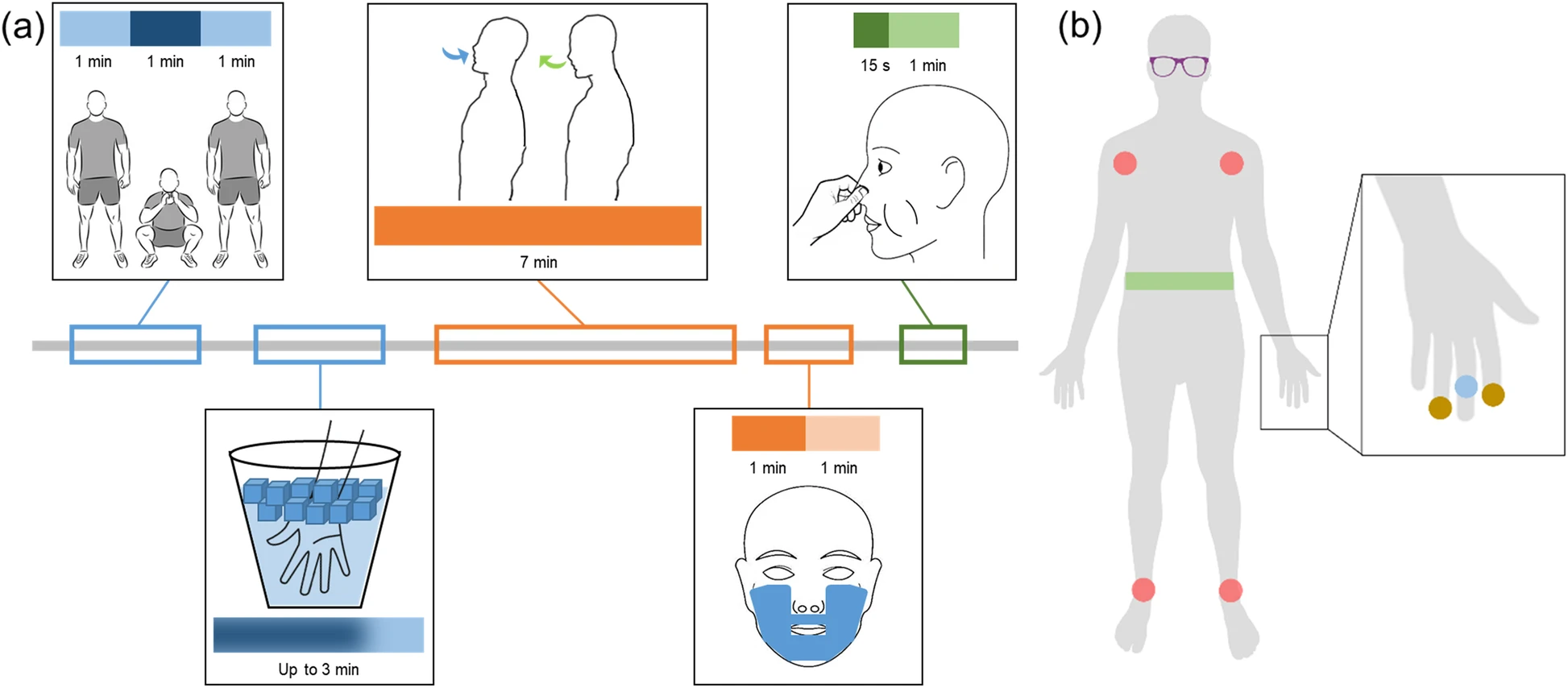
Twenty-one healthy adults were assessed in four sessions over two weeks while noninvasive sensors recorded heart activity, blood pressure, breathing, skin electrical activity and pupil diameter.
The method
In twenty healthy adults, stimulation at the neck was varied in frequency, intensity, electrode placement and duration, with heart rate variability and the brain's alpha-band activity as markers of the response.
What the work has shown
In a randomized, double-blind, sham-controlled pilot of 18 patients with lupus and musculoskeletal pain, four days of auricular stimulation significantly reduced pain and fatigue compared with sham.
In a single-blinded, sham-controlled crossover trial at two centers, stimulation of the tragus significantly reduced the burden of premature ventricular contractions compared with sham (P = 0.021) in 35 patients whose contractions had not responded to medication.
In 20 healthy adults, no single frequency of neck stimulation was best, but each participant had a preferred frequency, which raised a measure of heart rate variability by a mean of 41% at the first visit.
Five standard autonomic tests with noninvasive sensors, repeated in 21 healthy adults, yielded sympathetic and parasympathetic indices for a healthy population.
Publications
- 2026
Debnath S, Fylaktou F, Gurfein BT, Zanos TP. Autonomic and neural responses to varying transcutaneous cervical electrical stimulation parameters. Bioelectronic Medicine. 2026;12(1):16.
- 2025
Zafeiropoulos S, Coleman K, Kogan J, et al. TraNscutaneOus Electrical VAgus Nerve Stimulation to Suppress Premature Ventricular Contractions: A Crossover, Randomized Clinical Trial (NoVa-PVC). JACC: Clinical Electrophysiology. 2025;11(8):1699-1707.
Cited 9 times
- 2021
Debnath S, Levy TJ, Bellehsen M, et al. A method to quantify autonomic nervous system function in healthy, able-bodied individuals. Bioelectronic Medicine. 2021;7(1):13.
Cited 31 times
- 2021
Debnath S, Levy TJ, Zanos S, Zanos TP. Noninvasive, multimodal assessment of physiological responses to transcutaneous auricular vagus nerve stimulation. International IEEE/EMBS Conference on Neural Engineering (NER). 2021;1109-1112.
Cited 2 times
- 2020
Aranow C, Atish-Fregoso Y, Lesser M, et al. Transcutaneous auricular vagus nerve stimulation reduces pain and fatigue in patients with systemic lupus erythematosus: a randomised, double-blind, sham-controlled pilot trial. Annals of the Rheumatic Diseases. 2020;80(2):203-208.
Cited 184 times