
Skip to content
Division of Health AIDivision of Health AI
AboutTeamResearchPublicationsInternship
Division of Health AIDivision of Health AI

Clinical AI built with the data and clinicians of one of the largest health systems in the United States.

Explore

  • About
  • Team
  • Research
  • Publications
  • Internship

Affiliations

  • Feinstein Institutes↗ (opens in new tab)
  • Northwell Health↗ (opens in new tab)
  • Zucker School of MedicineHofstra Northwell

Located at

  • Institute of Health System Science
  • Institute of Bioelectronic Medicine
  • Manhasset, New York

© 2026 Division of Health AI, Northwell Health. All rights reserved.

Point-of-care AI · Active

← All research

Maternal fever / neonatal sepsis prediction

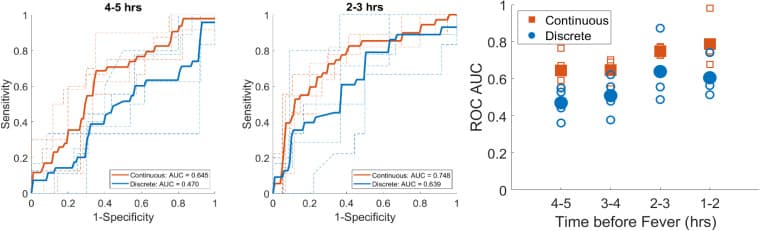
Continuously monitored vital signs and heart rate variability during labor predict maternal fever 2-3 hours before clinical onset, with area under the curve of 0.748, enabling early detection of mothers at risk for neonatal early-onset sepsis.
2 researchers·2 publications·2 figures

FEVERHRVTEMP
Point-of-care AIDivision of Health AI
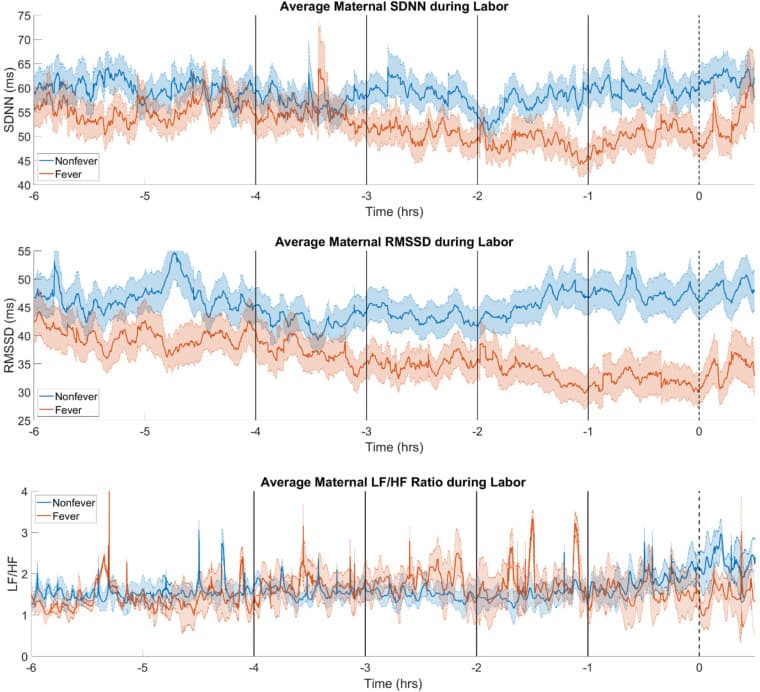
Average heart rate variability during labor for afebrile versus febrile mothers, separating two to three hours before fever onset.
Average heart rate variability during labor for afebrile versus febrile mothers, separating two to three hours before fever onset. Digital Health, 2023 · CC BY-NC-ND 4.0 (opens in new tab)
ROC curves across prediction horizons, reaching an AUC of 0.748 at two to three hours before fever onset.
ROC curves across prediction horizons, reaching an AUC of 0.748 at two to three hours before fever onset. Digital Health, 2023 · CC BY-NC-ND 4.0 (opens in new tab)

From the papers

Published figures

Figures reproduced from the open-access papers behind this project.

Each panel keeps its original source and license. Scroll the column at left to move through the published results while these notes stay in view.
People · 2

On this project

Theodoros Zanos, PhD

Professor & AVP

Shubham Debnath, PhD

Senior Research Scientist

Publications · 2

Related papers

View all →
Digital HealthJan 2023

Prediction of intrapartum fever using continuously monitored vital signs and heart rate variability

(opens in new tab)
Journal of Clinical Monitoring and ComputingJan 2021

Efficacy of continuous monitoring of maternal temperature during labor using wireless axillary sensors

(opens in new tab)

Related

More in Point-of-care AI

Generative AI for Minimal-Lead ECG Reconstruction

This project develops generative deep learning models to reconstruct multi-lead ECG signals from minimal input leads, assessing whether a small number of key ECG recordings can capture sufficient signal and diagnostic information for robust clinical interpretation and scalable cardiac monitoring.

Point-of-care AI

ACS RISKHIGHMODERATELOW

AI-Enabled ECG Risk Stratification for Acute Coronary Syndrome

Machine learning models identify high-risk acute coronary syndrome patients using admission ECG features and vital signs to predict in-hospital mortality and clinical deterioration, with interpretable outputs that guide triage and escalation decisions in acute cardiovascular care.

Point-of-care AI

ONSET

Delirium classification

Developing a machine learning framework to automatically identify delirium from clinical chart text using large language models, and building a predictive model to detect delirium onset early using clinical and physiological biomarkers.

Point-of-care AI

←Previous

In-hospital deterioration: wearable monitoring

Next→

Nursing workforce optimization