Skip to content
Division of Health AIDivision of Health AI
TeamResearchPublicationsJoin
Theme
Division of Health AIDivision of Health AI

Site

  • Team
  • Research
  • Publications
  • Join

Affiliated institutions

  • Feinstein Institutes (opens in new tab)
  • Northwell Health (opens in new tab)
  • Zucker School of Medicine (opens in new tab)

© 2026 Division of Health AI, Northwell Health. All rights reserved.

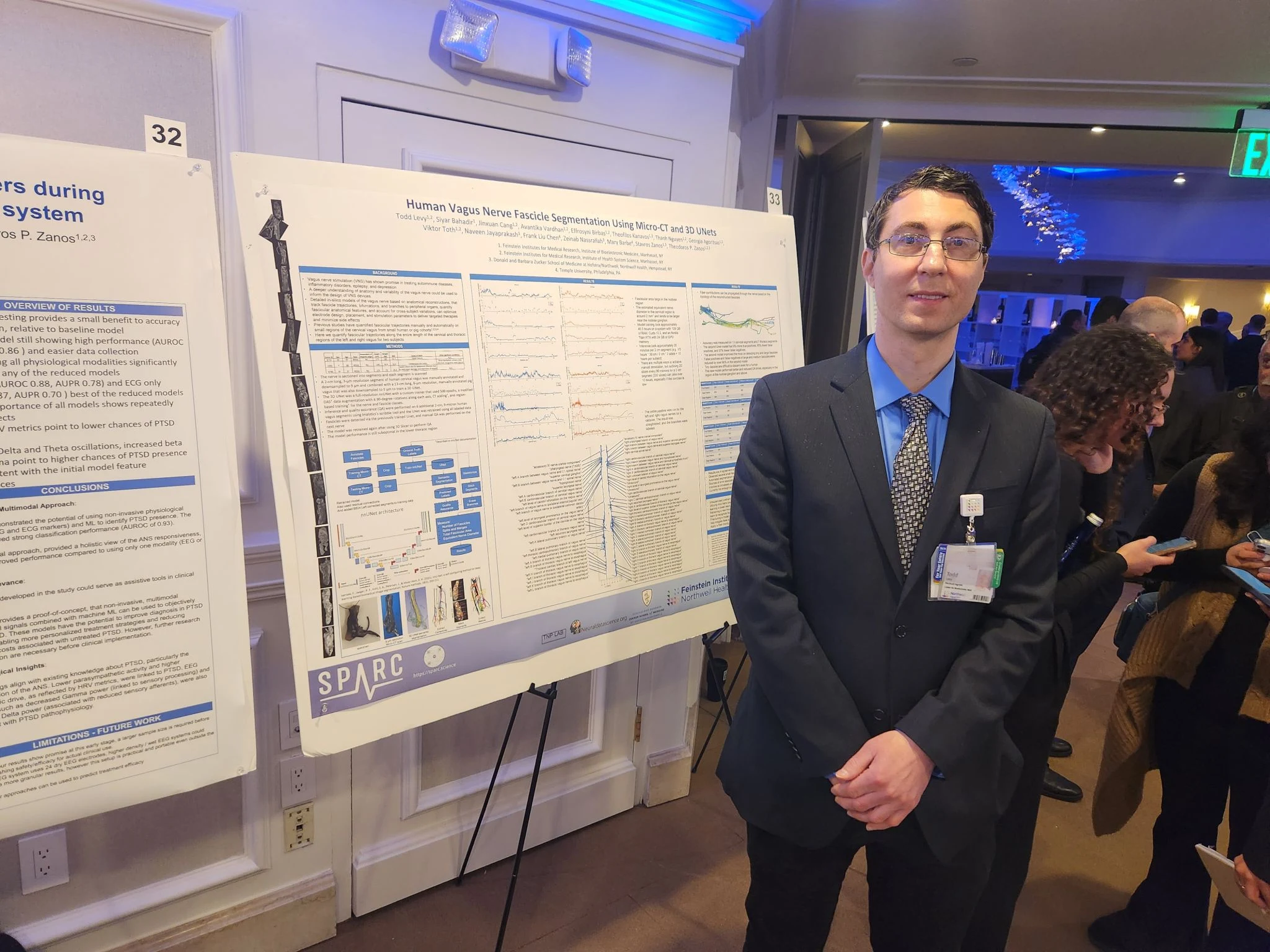
Todd Levy beside his poster on human vagus nerve fascicle segmentation at a SPARC meeting

Publications

Human vagus nerve fascicle segmentation, SPARC · Photo: Division of Health AI

2 publications · filtered

Clear filters
Digital Health · Jan 2023

Prediction of intrapartum fever using continuously monitored vital signs and heart rate variability

(opens in new tab)

Background: Fever during labor is associated with maternal and neonatal morbidity. Early identification of at-risk patients would enable timely clinical intervention. Objective: To develop and validate a predictive model of intrapartum fever using continuously monitored vital signs and heart rate variability (HRV). Methods: This was a prospective cohort study of 1,155 women in active labor. Raw vital signs and calculated HRV metrics were evaluated for their ability to predict fever (temperature >38.0°C) using logistic regression. Results: Fever was detected in 48 women (4.2%). Compared to afebrile mothers, febrile mothers had significantly decreased heart rate variability measures (SDNN and RMSSD) at 2-3 hours before fever onset (P<0.001). A predictive model built using continuous vital signs data outperformed a model built from episodic vital signs, with area under the curve of 0.81.

Digital Health

Jan 2023
Journal of Clinical Monitoring and Computing · Jan 2021

Efficacy of continuous monitoring of maternal temperature during labor using wireless axillary sensors

(opens in new tab)

This study aimed to determine whether continuous measurement of temperature during labor is feasible, accurate, and more effective than manual measurements for detecting fever. Women were recruited on admission in labor at greater than 35 weeks gestational age with less than 6 cm cervical dilation. Sensors were affixed in the axilla, which transmitted every 4 minutes by Bluetooth to a dedicated tablet. Conventional temperature measurements were taken every 3-6 hours per routine. Of 336 subjects recruited, 155 had both greater than 4 hours of continuous data and greater than 2 manual temperature measurements. Of 15 episodes of fever greater than 38 degrees C detected by both methods, 13 were detected earlier by continuous monitoring (9 of those more than 1 hour earlier). Manual measurements missed 32 fevers greater than 38 degrees C and 13 fevers greater than 38.5 degrees C that were identified by continuous monitoring. Continuous measurement of maternal temperature for the duration of labor is practical and accurate.

Journal of Clinical Monitoring and Computing

Jan 2021

More

Explore the researchMeet the teamInternships and PhD training