
Skip to content
Division of Health AIDivision of Health AI
AboutTeamResearchPublicationsInternship
Division of Health AIDivision of Health AI

Clinical AI built with the data and clinicians of one of the largest health systems in the United States.

Explore

  • About
  • Team
  • Research
  • Publications
  • Internship

Affiliations

  • Feinstein Institutes↗ (opens in new tab)
  • Northwell Health↗ (opens in new tab)
  • Zucker School of MedicineHofstra Northwell

Located at

  • Institute of Health System Science
  • Institute of Bioelectronic Medicine
  • Manhasset, New York

© 2026 Division of Health AI, Northwell Health. All rights reserved.

Autonomic Nervous System AI · Active

← All research

VNS treatment efficacy in epilepsy

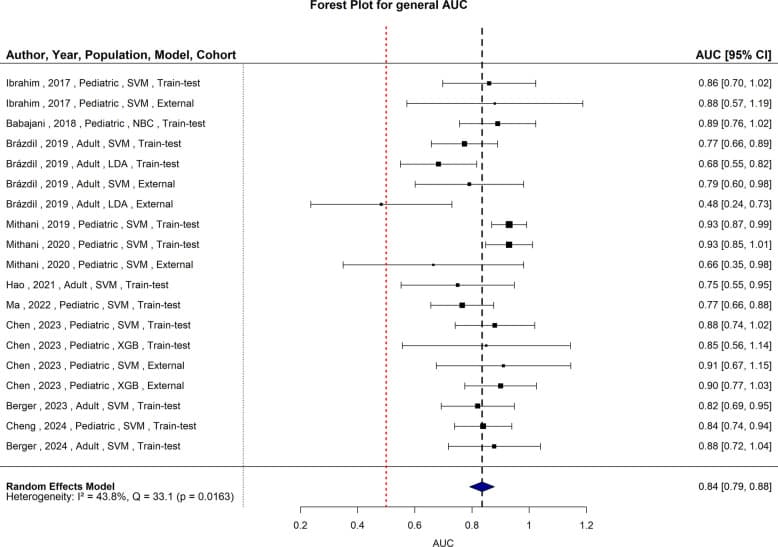
Machine learning models can predict which patients with drug-resistant epilepsy will respond to vagus nerve stimulation therapy, achieving an average area under the receiver operating characteristic curve (AUROC) of 0.84 across 12 studies comprising 535 patients.
2 researchers·1 publication·3 figures

VNSRESPONDERNON-RESPONDER
Autonomic Nervous System AIDivision of Health AI
Forest plot of weighted AUROC across all machine learning models for predicting VNS response, pooling to 0.84.
Forest plot of weighted AUROC across all machine learning models for predicting VNS response, pooling to 0.84. Bioelectronic Medicine, 2025 · CC BY-NC-ND 4.0 (opens in new tab)
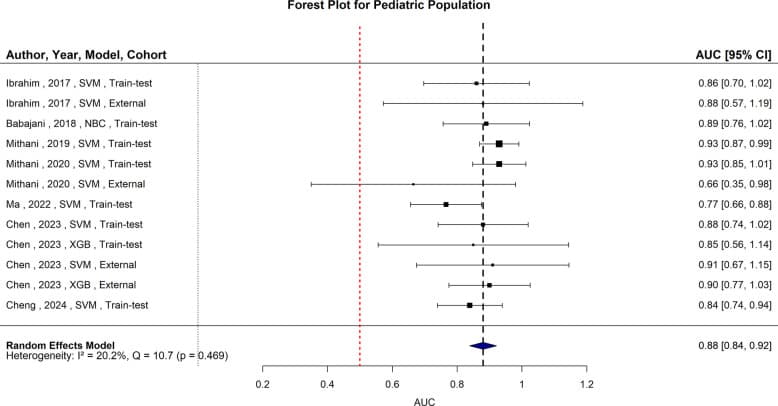
Pediatric-only cohorts show higher predictive performance (AUROC 0.88) and lower heterogeneity than adults.
Pediatric-only cohorts show higher predictive performance (AUROC 0.88) and lower heterogeneity than adults. Bioelectronic Medicine, 2025 · CC BY-NC-ND 4.0 (opens in new tab)
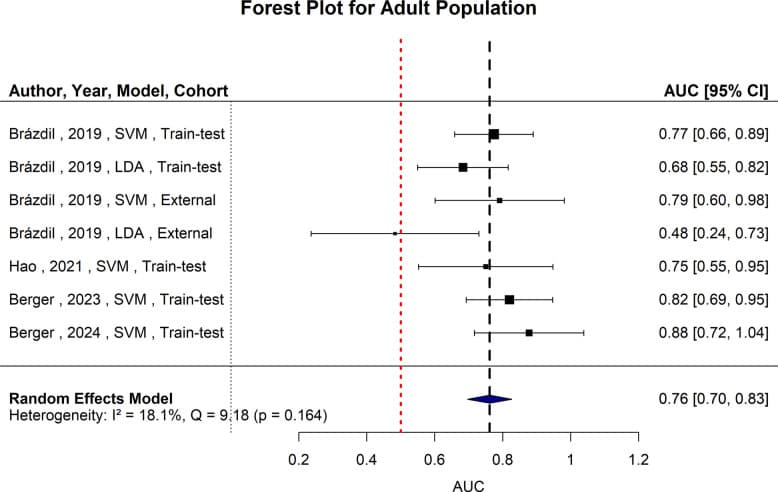
Adult-only cohorts predict VNS response less accurately (AUROC 0.76) than pediatric populations.
Adult-only cohorts predict VNS response less accurately (AUROC 0.76) than pediatric populations. Bioelectronic Medicine, 2025 · CC BY-NC-ND 4.0 (opens in new tab)

From the papers

Published figures

Figures reproduced from the open-access papers behind this project.

Each panel keeps its original source and license. Scroll the column at left to move through the published results while these notes stay in view.
People · 2

On this project

Theodoros Zanos, PhD

Professor & AVP

Alejandro Quintero Villegas, MD

Elmezzi Scholar

Publications · 1

Related papers

View all →
Bioelectronic MedicineNov 2025

Predicting response to neuromodulation therapies in drug-resistant epilepsy using machine learning models: a meta-analysis and systematic review

(opens in new tab)

Related

More in Autonomic Nervous System AI

SEVEREMODERATECONTROL

PTSD detection from physiological signals

Machine learning models identify PTSD from non-invasive physiological signals, including heart rate variability, in a study currently under review. The lab also studies transcutaneous auricular vagus nerve stimulation as a potential PTSD treatment for World Trade Center responders with limited response to existing therapies.

Autonomic Nervous System AI

←Previous

Vagus nerve digital twin (REVA)

Next→

PTSD detection from physiological signals