Skip to content
Division of Health AIDivision of Health AI
TeamResearchPublicationsJoin
Theme
Division of Health AIDivision of Health AI

Site

  • Team
  • Research
  • Publications
  • Join

Affiliated institutions

  • Feinstein Institutes (opens in new tab)
  • Northwell Health (opens in new tab)
  • Zucker School of Medicine (opens in new tab)

© 2026 Division of Health AI, Northwell Health. All rights reserved.

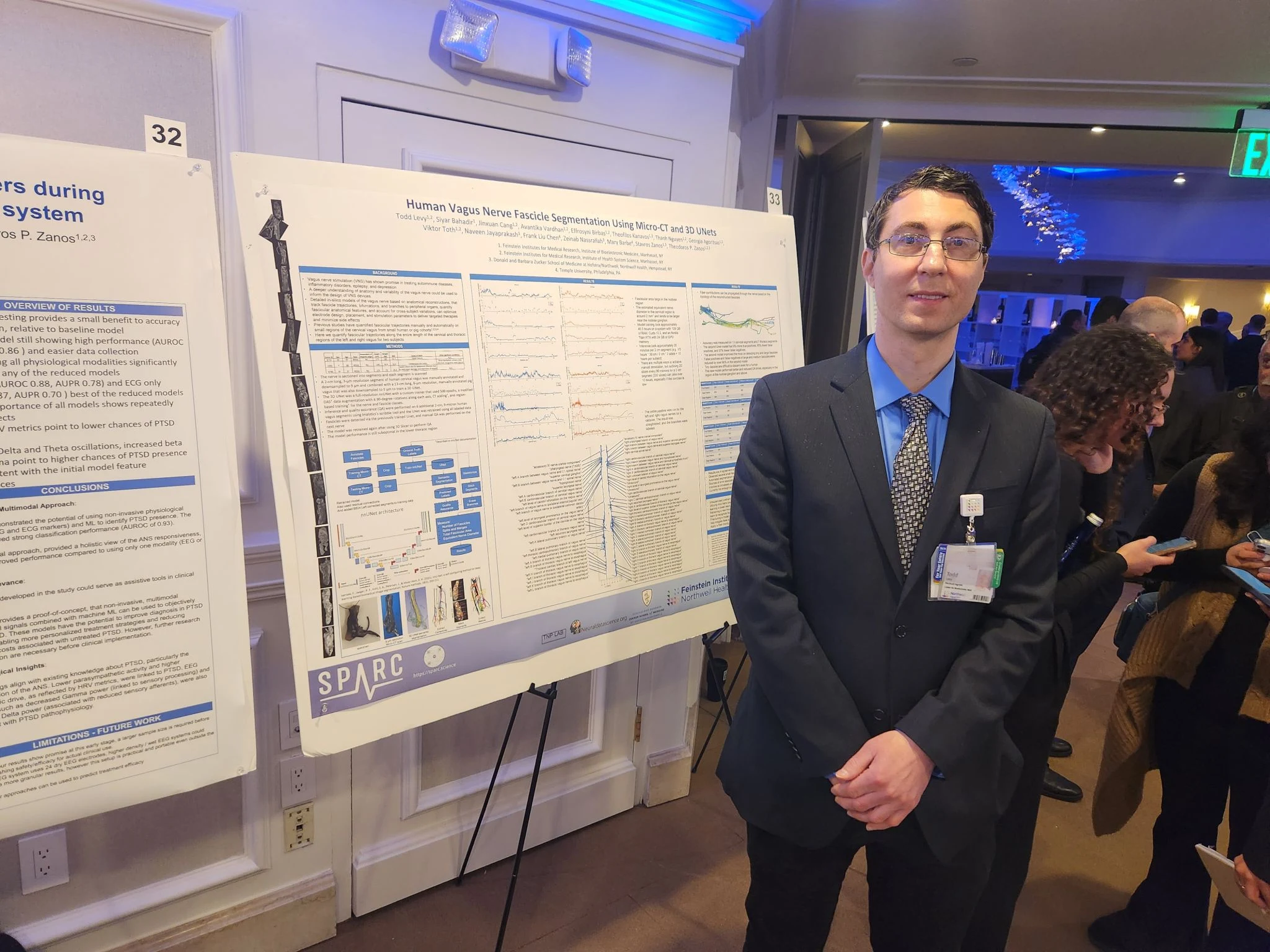
Todd Levy beside his poster on human vagus nerve fascicle segmentation at a SPARC meeting

Publications

Human vagus nerve fascicle segmentation, SPARC · Photo: Division of Health AI

3 publications · filtered

Clear filters
Cancers · Dec 2024

A Systematic Review of the Applications of Deep Learning for the Interpretation of Positron Emission Tomography Images of Patients with Lymphoma

(opens in new tab)

This systematic review examined the applications of deep learning for the interpretation of lymphoma positron emission tomography (PET) images. From 71 papers initially retrieved, 21 studies with a total of 9402 participants were ultimately included. The proposed deep learning models achieved promising performance in various medical tasks, including detection, histological subtyping, differential diagnosis, and prognostication. AI-based analysis of lymphoma whole-body FDG-PET/CT can inform all phases of clinical management including staging, prognostication, treatment planning, and treatment response evaluation. AI methods demonstrated promising predictive performance (AUC range = 0.68–0.85) on PET-based images, with higher values for deep learning methods. AI techniques for lymphoma PET evaluation are designed to assist physicians in handling large volumes of scans through rapid and accurate calculations.

Cancers

Dec 2024
Journal of Surgical Oncology · Aug 2024

Machine learning to predict completion of treatment for pancreatic cancer

(opens in new tab)

While chemotherapy enhances survival rates for pancreatic cancer patients after surgery, less than 60% complete adjuvant therapy, with a smaller fraction undergoing neoadjuvant treatment. This study aimed to predict which patients would complete pre- or postoperative chemotherapy through machine learning, grouping patients with resectable pancreatic cancer into those who completed all intended treatments and those who did not. Researchers applied logistic regression with lasso penalization and an extreme gradient boosting model for prediction. Among 208 patients with median age of 69 (49.5% female, 62% white), neoadjuvant and adjuvant chemotherapies were received by 26% and 47.1%, respectively, but only 49% completed all treatments. Negative prognostic factors included worsening diabetes, age, congestive heart failure, high body mass index, family history of pancreatic cancer, initial bilirubin levels, and tumor location in the pancreatic head. Predictive accuracy (AUROC) was 0.67 for both models, with performance expected to improve with larger datasets.

Journal of Surgical Oncology

Aug 2024
Cancers · Jan 2024

Deep Learning Applications in Pancreatic Cancer

(opens in new tab)

Pancreatic cancer is one of the most lethal gastrointestinal malignancies. Despite advances in cross-sectional imaging, chemotherapy, radiation therapy, and surgical techniques, the 5-year overall survival is only 12%. With the advent and rapid adoption of artificial intelligence (AI), specifically deep learning (DL), into healthcare systems, there is potential for utilizing AI applications across the entire pancreatic cancer patient journey. This review examines the current applications of DL and other AI modalities in the diagnosis, management, monitoring, and prognostic assessment of patients with pancreatic cancer. The scope covers diagnostic imaging, surgical planning, therapeutic monitoring, and development of novel biomarkers. We conducted a comprehensive review of English language publications from January 2019 to November 2023 in the PubMed database using keywords including pancreatic cancer, deep learning, radiomics, large language models, and generative adversarial networks.

Cancers

Jan 2024

More

Explore the researchMeet the teamInternships and PhD training