Skip to content
Division of Health AIDivision of Health AI
TeamResearchPublicationsJoin
Theme
Division of Health AIDivision of Health AI

Site

  • Team
  • Research
  • Publications
  • Join

Affiliated institutions

  • Feinstein Institutes (opens in new tab)
  • Northwell Health (opens in new tab)
  • Zucker School of Medicine (opens in new tab)

© 2026 Division of Health AI, Northwell Health. All rights reserved.

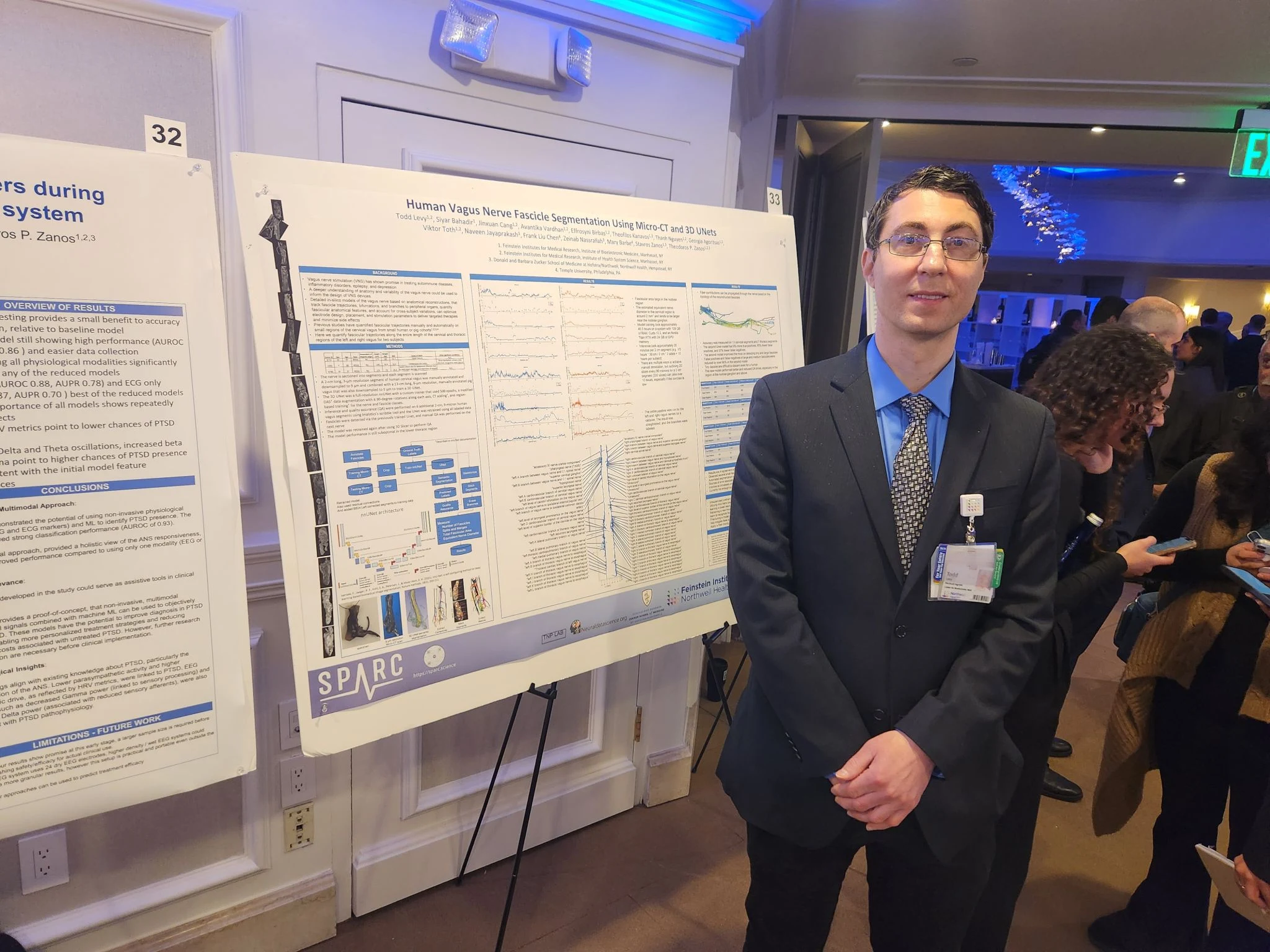
Todd Levy beside his poster on human vagus nerve fascicle segmentation at a SPARC meeting

Publications

Human vagus nerve fascicle segmentation, SPARC · Photo: Division of Health AI

3 publications · filtered

Clear filters
Journal of Cardiovascular Electrophysiology · Sep 2025

Leveraging Implantable Cardiac Defibrillator Remote Transmissions to Predict the Occurrence of Atrial Fibrillation

(opens in new tab)

Atrial fibrillation (AF) and heart failure (HF) frequently coexist in patients, with development of AF often preceding HF decompensation. This study evaluated whether daily remote monitoring of implantable cardioverter-defibrillator (ICD) parameters could predict AF occurrence using machine learning techniques in a real-world cohort. Data from patients with primary prevention ICDs transmitted daily to the Northwell centralized remote monitoring center between 2012 and 2021 were analyzed. An XGBoost model was trained to predict AF occurrence with a 3-day time horizon using a 14-day data collection sequence in 207 patients (69.0% male, median age 65.0 years, median ejection fraction 30%). The model predicted AF occurrence within the following 3 days in 49 (23.7%) patients after a median of 36 months post-implant with an AUROC of 0.79 and AUPRC of 0.10. Key variables included RV and RA sensing amplitudes and pulse width, suggesting machine learning approaches have potential to predict AF from daily remote ICD monitoring.

Journal of Cardiovascular Electrophysiology

Sep 2025
JACC: Clinical Electrophysiology · Apr 2025

TraNscutaneOus Electrical VAgus Nerve Stimulation to Suppress Premature Ventricular Contractions: A Crossover, Randomized Clinical Trial (NoVa-PVC)

(opens in new tab)

The NoVa-PVC trial was a 2-center, prospective, sham-controlled, single-blinded, crossover randomized clinical trial conducted in patients with symptomatic premature ventricular contractions (PVCs) with at least 5% daily PVC burden and who were refractory to medical therapy. Participants received two sequential, 10-day sessions of active low-level tragus stimulation (LLTS; 20 Hz, 1 mA below the discomfort threshold) and sham stimulation (earlobe stimulation). Each treatment was interrupted by an 8-day washout period. Of 36 randomized patients, 35 [19 (59.4%) male, mean age 58.0 (±17.1) years] were included in the analysis with median baseline PVC burden of 14.83±10.08. LLTS significantly reduced PVC burden compared to sham stimulation [12.8 ± 10.9% vs 9.9 ± 8.3%, p=0.021]. In patients with symptomatic PVCs refractory to medical therapy, non-invasive low-level tragus stimulation significantly reduced median PVC burden (median reduction ~13.4% vs ~8.6%; P = 0.021).

JACC: Clinical Electrophysiology

Apr 2025
IEEE Transactions on Biomedical Engineering · Aug 2019

Towards personalized closed-loop mechanical CPR: a model relating carotid blood flow to chest compression rate and duration

(opens in new tab)

The objective was to determine if it is possible to model the response of the carotid blood flow to different chest compression waveforms as a function of time during resuscitation from cardiac arrest. Several approaches were tested to predict the carotid blood flow generated by the next chest compression based on knowledge of the duration of resuscitation, the chest compression rate, and the last compression's carotid blood flow. A single physiological metric, carotid blood flow, combined with information about the duration of resuscitation and the compression rate was sufficient to model and predict carotid blood flow in the next compression. This suggests that closed loop mechanical CPR is a viable medical device target.

IEEE Transactions on Biomedical Engineering

Aug 2019

More

Explore the researchMeet the teamInternships and PhD training