Skip to content
Division of Health AIDivision of Health AI
TeamResearchPublicationsJoin
Theme
Division of Health AIDivision of Health AI

Site

  • Team
  • Research
  • Publications
  • Join

Affiliated institutions

  • Feinstein Institutes (opens in new tab)
  • Northwell Health (opens in new tab)
  • Zucker School of Medicine (opens in new tab)

© 2026 Division of Health AI, Northwell Health. All rights reserved.

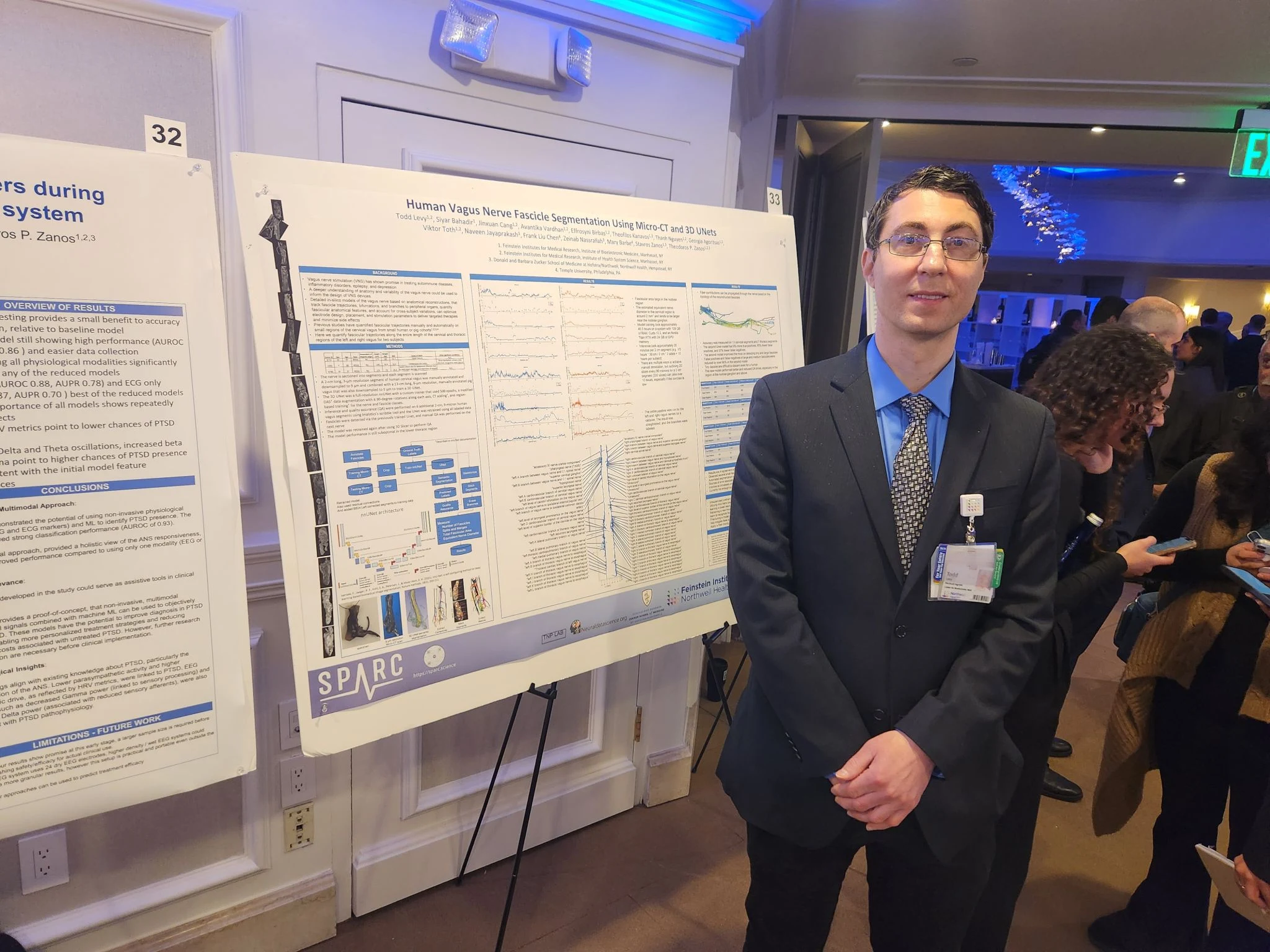
Todd Levy beside his poster on human vagus nerve fascicle segmentation at a SPARC meeting

Publications

Human vagus nerve fascicle segmentation, SPARC · Photo: Division of Health AI

3 publications · filtered

Clear filters
Bioelectronic Medicine · Aug 2021

A method to quantify autonomic nervous system function in healthy, able-bodied individuals

(opens in new tab)

The autonomic nervous system (ANS) maintains physiological homeostasis in various organ systems via parasympathetic and sympathetic branches. Reliable, sensitive, and quantitative biomarkers of ANS function, first defined in healthy participants, could discriminate among clinically useful changes. This framework combines controlled autonomic testing with feature extraction during physiological responses. Twenty-one individuals were assessed in two morning and two afternoon sessions over two weeks. Each session included five standard clinical tests probing autonomic function: squat test, cold pressor test, diving reflex test, deep breathing, and Valsalva maneuver. Noninvasive sensors captured continuous electrocardiography, blood pressure, breathing, electrodermal activity, and pupil diameter. The battery of autonomic tests can be completed within 30 minutes and all sensors are non-invasively placed.

Bioelectronic Medicine

Aug 2021
International IEEE/EMBS Conference on Neural Engineering (NER) · May 2021

Noninvasive, multimodal assessment of physiological responses to transcutaneous auricular vagus nerve stimulation

(opens in new tab)

Transcutaneous auricular vagus nerve stimulation (taVNS) is a noninvasive method of applying current at the cymba conchae of the outer ear to target the auricular branch of the vagus nerve. Recent efforts have shown therapeutic effects of taVNS on clinical populations, but the mechanism and autonomic nervous system (ANS) responses are not well understood. Twenty-one individuals were tested in four sessions over two weeks; taVNS was applied at the left ear while noninvasive sensors captured electrocardiography, blood pressure, breathing, electrodermal activity (EDA), and pupil diameter (PD). Physiological markers derived from these biosignals allowed for assessment of how taVNS affects the autonomic nervous system.

International IEEE/EMBS Conference on Neural Engineering (NER)

May 2021
Annals of the Rheumatic Diseases · Nov 2020

Transcutaneous auricular vagus nerve stimulation reduces pain and fatigue in patients with systemic lupus erythematosus: a randomised, double-blind, sham-controlled pilot trial

(opens in new tab)

Musculoskeletal pain and fatigue are common features in systemic lupus erythematosus (SLE). The cholinergic anti-inflammatory pathway is a physiological mechanism diminishing inflammation, engaged by stimulating the vagus nerve. We evaluated the effects of non-invasive vagus nerve stimulation in patients with SLE and with musculoskeletal pain. 18 patients with SLE and with musculoskeletal pain were randomised (2:1) in this double-blind study to receive transcutaneous auricular vagus nerve stimulation (taVNS) or sham stimulation (SS) for 4 consecutive days. Evaluations at baseline, day 5 and day 12 included patient assessments of pain, disease activity (PtGA) and fatigue. Tender and swollen joint counts and the Physician Global Assessment (PGA) were completed by a physician blinded to the patient's therapy. Potential biomarkers were evaluated. taVNS and SS were well tolerated. Subjects receiving taVNS had a significant decrease in pain and fatigue compared with SS and were more likely (OR=25, p=0.02) to experience a clinically significant reduction in pain. PtGA, joint counts and PGA also improved. Pain reduction and improvement of fatigue correlated with the cumulative current received. In general, responses were maintained through day 12. Plasma levels of substance P were significantly reduced at day 5 compared with baseline following taVNS but other neuropeptides, serum and whole blood-stimulated inflammatory mediators, and kynurenine metabolites showed no significant change at days 5 or 12 compared with baseline. taVNS resulted in significantly reduced pain, fatigue and joint scores in SLE. Additional studies evaluating this intervention and its mechanisms are warranted.

Annals of the Rheumatic Diseases

Nov 2020

More

Explore the researchMeet the teamInternships and PhD training